Machine-generated transcript, lightly edited for readability. It may contain transcription errors.
It's tricky when you're dating somebody. Is it because of how amazing you are or how wealthy you are? The mindset is suspicious many times because everybody wants something from them since day one. Is that to protect themselves?
When actually it's layers and layers of protection. See a billion-dollar family that wouldn't even speak to other billion-dollar friends. They feel comfortable to speak to a guy who only has $50 million about price divorce. Why is that?
Because then they feel that it's a safe environment. Nobody's judging them. Nobody's there. Nobody wants something from them.
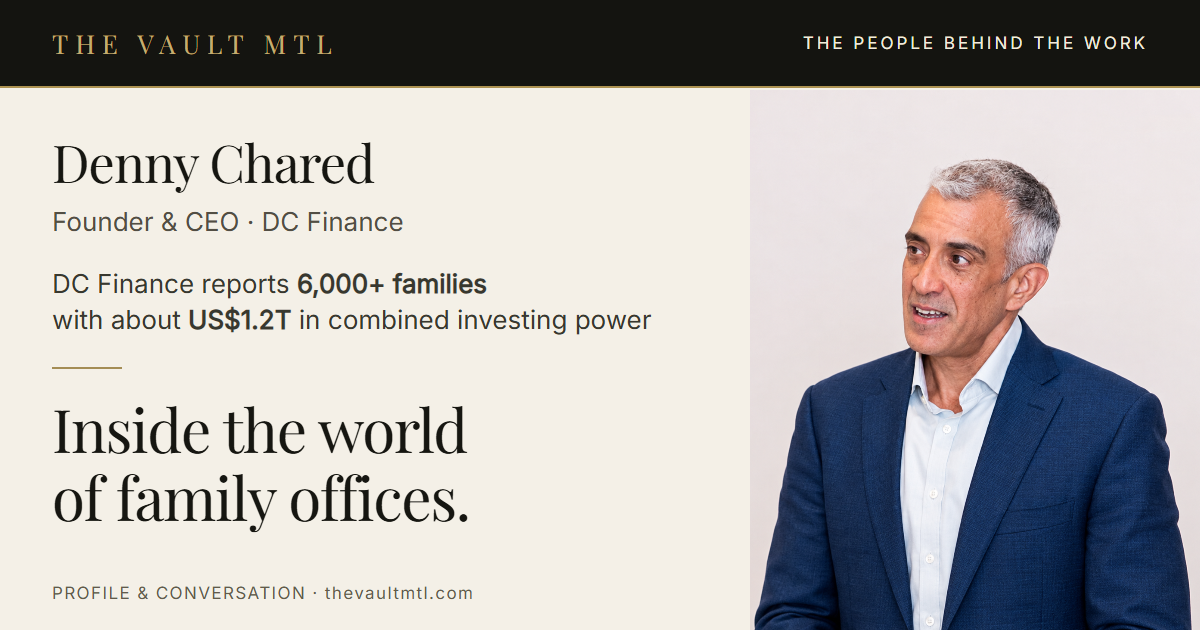
Everybody were verified before. No meetings. And for those who don't know your world, can you please give us like a 20-second view on what you've built? We are in the family office world, the family office and high net worth world, which is basically kind of a parallel universe, I would say, of the wealthy individuals and how they manage their wealth.
Family office is usually You— it means to describe an internal operation that wealthier families are normally above $100 million would have, which is their own CPA, their own legal guys, their own investment guys that take care of everything from their school needs of their kids all the way to investments. And usually it's a team within the office of the wealthy family. So that's really— and we deal with everything. We do conferences, we have a club, and that really discusses everything on their agenda for estate planning, next generation, coin investing, arts, philanthropy, marrying wealth, more importantly divorcing it, and everything else that you can even— Divorce?
Yep. Mental health. Wow. So it's like everything is included, basically.
Yeah. Yeah. That's really good. Tomorrow you're bringing together some of the wealthiest families and investors in one room at the conference.
What actually happens in that room that most people don't understand or don't see? Well, we discussed those topics that I've mentioned. Closed doors, no media is allowed. So it's very private.
And we share, you know, the recent trends in investments, what you need to talk about, you know, with what's going on in the world, oil and gas or, you know, anything that defense and technology. All the way to, um, to, uh, very, you know, sensitive issues like, um, issues to do with, uh, mental health and transition of, uh, wealth to the next generation. Hearing the stories of entrepreneurs and how they build their businesses and the challenges that they deal with. And there's a lot of issues that wealthy families deal with, you know.
If you think about being a, a daughter of a famous singer, that's a lot of burden. Everybody are thinking You know, putting you in their shadows, expecting at least that if you're the daughter of a very wealthy, successful entrepreneur, they all give you a harder time because you were there because you're the daughter of the founder. And then you need to prove yourself if you even care about that world. It's not easy.
It comes with a lot of issues. You know, I've seen tough stories in our space, all sorts from families where I speak to the next generation that are Um, that feel like they were neglected by their parents and were brought up by the nannies and saying, I wish they didn't do that and were, you know, spending more time with me. But I also always tell them, guys, it's, uh, uh, it's nice to speak, you know, nice. I mean, from your perspective, you know, having a lot of wealth, it's easy to say that, but you don't know what happens when you don't have money, right?
I mean, um, you can, you can you know, cry about the time you miss with your parents. But on the other hand, being without money has its own issues. And maybe that's what they needed to do in order to get further. And what if you're a successful singer or a musician or whatever?
Yeah, you need to do more. You need to travel and the kids pay the price. But at the same time, I personally think that one should live up to its, you know, to its— follow his ambition and reach whatever the stars. I don't think because you have kids you need to you know, give up on that.
And I think there are many kids that would be even disappointed that their parents gave up on stuff. But, you know, you need to find some balance. Yeah. But what I'm saying is, and mental health issues, you know, when you're getting, again, being in the shadow of somebody can put them in turmoil and end up, you know, lost or on drugs or, you know, in Canada, there's a very high rate of suicide, and especially in Vancouver.
I don't know why Vancouver, maybe because, I don't know, the weather is nicer and lots of homeless people end up there. But I've seen many stories even here in Canada. I had this VC guy that told me that his kids are either— he has 2 kids. He has no idea where they are right now.
They might be under a bridge or under whatever. Really? They're doing drugs. There's no way to get them out of that.
And he says, every time I get a phone call, it could be somebody calling me to tell me, you know, my son is dead. And this is a very successful VC guy. And I had the founder of— what's the name of your famous Starbucks cup? Tim Hortons?
No, no, the other one. Second Cup. Okay. So I had the founder of Second Cup, co-founder, share online with us.
It was something actually that we did online. that he was, uh, sexually abused as a child, thrown to the streets of Toronto, and being— I think he was homeless until, I don't know, 17. And then he made a change, and he wants to share that so people will know and, uh, you know, not give up hope and see that you can actually end up one of Canada's most well-known entrepreneurs if you can make that move, you know, that change. So lots of stuff.
You deal with a lot of crazy stories. Yeah, there's a misconception that rich people or wealthy people have less problems. But on both sides of the spectrum, there are— everybody has their own issues that they're dealing with. How do you decide who belongs in those spaces and what disqualifies them?
So we're trying to find interesting speakers, people that are either interesting family members from known families or entrepreneurs that, that have a great story. Holly actually spoke last year. about how he, you know, started the business from nothing and, and, and, you know, ended up where he has. I like to bring interesting people.
I used to be a journalist covering Wall Street back in the day. Yes. And I think that and my ADHD combination is— came to be about getting interesting stories from people. I'm really, you know, fed up with listening to more, you know, middle of the road, you know, commercially accepted stories from people that are kind of boring.
I like to get the real deal, the actual stories behind it from those who are willing to share. What is the vetting process like? It's not a vetting. It's more like, you know, if you're coming from a known prominent family, you know, we would definitely love to have you.
I'll try to see if one of the, you know, generations is doing something interesting, leading philanthropic, I don't know, ventures or anything like that. And many times people suggest names. Okay. You know, and I get a lot of introductions.
So that's how we end up with interesting people. And you mentioned about your background, you were a journalist. What has that taught you as well when it comes to trust and especially in a community like this? So our community is unfortunately filled with fraudulent groups and okay groups that they're the definition of family is very flexible.
Some would treat anybody with a family and an office to be a family office. And so very few, I think, are real groups. I can really count on one hand those that I think are, are legit. And, um, I think coming from the journalistic world made me pretty tough on doing my due diligence on speakers, on attendees, on everything that moves.
I think I have a growing group of haters out there that, uh, you know, keep on saying, oh, but the other guys let us in. And we couldn't care less who lets you in if you didn't show me. You know, there was now a big article in New York Magazine about a lady that came with a guy who she claimed to be her boyfriend who's a Rockefeller. Yeah.
And throughout the years, she's very aggressive getting, you know, herself to, uh, um, to events she was never invited to. And she managed to get away even to lead panels at conferences. Really? And whenever I— and I questioned her from day one.
I mean, like, uh, I said, you know, show me anything that supports what you're saying, that you're coming from this major family. Show me. Oh no, forget about that, but I, I, I, uh, I manage wealth of a big UAE family. I said, All right, show me.
Give me a letter, something. I mean, you know, and then she comes back with a letter that had more spelling mistakes than, than, than my kids', uh, my 5-year-old's, uh, essay. And I was like, come on, this is, this is not serious. And she came crashing our conferences and we kept her out.
She was sending people my way that know me, that probably have very low, uh, level of diligence that they do, and they try to convince me to let her in, and we didn't. And now a huge article on New York Magazine. Turns out she's a complete fraud, broke. Her boyfriend is an actor, nothing to do with Rockefeller.
Wow. This is just one example, but I have others throughout the years that— so I think journalism taught me to check, you know, check things. You don't just take them for granted. So you said there's a lot of fraudulent people in the industry.
Fraudulent and groups that cannot get the real deal. So they'll settle with anybody with a pulse can speak at their conferences. If they cannot get the real families, they'll get whomever. And it's enough for a family to mention that they are one thing or another and they'll just take them for their word instead of checking them.
Or— and there's another thing, there are families that have nothing to do with wealth anymore. You know, there's a very nice guy, DuPont family, very, you know, known family, right? one of the most famous electronic brands in the world. But today, I think there are hundreds at this generation.
It's an old family. It's like, I don't know, 150 years old. There are hundreds of them now. Okay.
They don't have the wealth that the original, you know, family had at all. Okay. And the fact they have that last name is not enough to justify to bring somebody who's actually a business development guy at a VC firm To speak at a conference because he's a business development guy at a VC firm. He's coming to sell a VC, a venture fund.
Okay. So stuff like that. So they could be legit in the sense that they belong to that family, but debt and connection to wealth is is not there. So others would grab whatever you got because you have the right last name without really checking.
Wait a minute. Are you are you are you selling Scotia now? Are you truly a family office? You know, you could be a— you can actually be a wealthy family member, but you're working as a business development private wealth of Scotia.
So I don't want you there because the only thing you care about is to network and bring those families to be your clients. Yeah, many times these guys are hired because they walk the walk and talk the talk. Okay, but I don't want them for that reason. Then they become sell-side for me.
Doesn't matter how much money they have. So we, we kind of try to you know, draw the line between sell side and buy side. For me, buy side are anybody who are really truly families who purchase, who buy, who have purchasing power and are not selling anything to anybody because that's important for the integrity of the room. Yeah.
And do you have any people that do go just to like service providers, maybe lawyers, accountants? So we have private dinners in there. They cannot go. But for the conference, we limit the number of tickets we sell.
So like, I think around 15 tickets can be sold to them if they would like to. And we have also a private club chaired by Lisa Silverstein, the next generation of the World Trade Center, where it's only ultra-high net worth who meet around the events. And there you cannot, uh, really, um, uh, join any of that unless you are above, uh, $40 million in liquid assets. Um, but you can be, you can be a person that also has a sell side.
You can have a fund. You can have, you can be somebody that has an exit. But otherwise, you know, you kind of really be part of that. And what was the play in bringing in Lisa into the mix?
It's not bringing in Lisa as much as it was their idea. It was their idea. So I know them very well, the family, and especially her husband Tal, whom we joke together. And when we joke, sometimes ideas come up.
And one of them was, hey, you know what? You got all these destinations out there. We're in 20 cities around the world. which probably makes us one of the world's largest groups.
Definitely. And, you know, why don't we make— instead of running randomly into a family at a conference, why don't we get curated group of people together? And we don't want any common ground beyond the fact that they need to be good people and they need to be wealthy. Otherwise, we want to mix them up.
You know, you have all these groups around impact, around family business. YPO wants you to be a young president. All good. We don't want any of that.
We want to mix different mindsets, right? One, we want to mix new wealth and old wealth. Okay. Because old money can learn from— maybe want to invest with new money because these guys are cutting edge, running, go-getters still, you know, with energy.
There aren't too many entrepreneurs, especially in technology, that have an exit and say, okay, let's go to the beach and take it easy. They don't. Yeah. A real entrepreneur, it's in his blood.
It's nothing you can take away. It's not money anymore. So they want to be with them. At the same time, new money can learn from old money stuff like mental health, legacy, next generation, all this stuff that these guys have been living forever.
And then that— so one is new wealth versus old wealth. The other is different cities. Simp— we don't have chapters, so every time we meet people from different cities, the club meets around the conferences. And so different cities.
And, and third, different sectors, because I want somebody from blockchain to sit with somebody from real estate and talk to somebody from technology. Okay, they all have different perspective about issues, about life, about whatever it is, and they can invest with each other. And they don't mix enough because they're stuck in their own circle. So that's the idea of the club.
It's chaired by a family, which by the way, I don't know many groups or any that are chaired by a family and not by an executive like myself. And we meet at the homes of other prominent families before the conferences. So we've been at the Spielbergs in LA, Crown in Chicago, 7-Eleven in Dallas, Saks Fifth Avenue in New York, and so on and so forth. What would you say about their mindset that is different from the average people?
It depends on the family, really. You know, there's a lot of different folks out there. Some, some, you know, sometimes you see next gens that are too full of themselves. We try to stay away from these guys.
We don't like ego so much. We're not. doesn't work good with us. So some that are really, you know, like that, but some that are really serious, that know the legacy of their family and the name they carry, and they don't brag.
Um, and, um, I think the mindset is suspicious many times because everybody wants something from them since day one. Yeah. Especially when you get to the billions. When you're in the billions, it's tricky when you're dating somebody.
Is it Because of how amazing you are or how wealthy you are? If somebody calls you or emails you, what's the endgame? There is an endgame. Are they using you?
Are they trying to get at the end of the day something out of you? So you can understand that some may come out as, um, um, maybe, uh, a little bit arrogant. Is that to protect themselves? When actually it's layers and layers of protection.
Okay. And sometimes, uh, I think that's part of this thing you see in the club. You see them open up. You see a billion-dollar family that wouldn't even speak to other billion-dollar friends because, you know, some stuff you just cannot talk about because it's— and then they feel comfortable to speak to a guy who only has $50 million about a surprise divorce.
Why is that? Because then they feel that it's a safe environment. Nobody is judging them. Nobody's there.
Nobody wants something from them. Everybody were verified before. No media. You meet at someone's home.
So it's just that environment. So I think the mindset of families would be a little bit more suspicious sometimes, you know, or careful. Guarded. Yeah.
Okay. So you create the environment for them to feel vulnerable to share their challenges and problems. I like that idea. And you operate at a very high level constantly.
Like you said, you were flying around. What does that actually cost you, or is there a price to pay for somebody in your position? Well, I mean, you get to travel a lot. I mean, sometimes it's annoying, but many times it's fun because, you know, you get to go to travel the world.
And, you know, when I was a journalist, I thought, gee, gee, I'm meeting everybody I want. It's so amazing. And it's so not when you compare it to what I do, because I meet all these amazing families, all these brands that you see outside. You know, I just meet them— 7-Eleven, uh, Vanderbilt, all these guys.
And, uh, you just hear amazing stories from amazing people that there's no other occupation that would have brought me there. None. I mean, you can be the head of real estate at JP Morgan and still you'd speak only to the real estate guys. You will not see the— you know, when you build a conference, there are so many different topics, right?
Uh, arts, uh, real estate, technology, uh, whatever, every— everything you can dream about. And I meet the people from all those circles. Now where can you do that? Even as a journalist, you know, you usually cover something, technology or this, one angle.
Here you're just mixed with all those angles and 20 different locations. So I'm meeting all those circles in different cultures. Abu Dhabi is not London and London is not Montreal and Montreal is not Vancouver. So I guess that's what's interesting.
But it is, yeah, it is draining sometimes. You know, there's a lot going on, but I can't complain too much, actually, because you love what you do. I was a journalist at some point. I didn't want to do that anymore because I was tired of writing about other great people.
I wanted to become one myself. But then I left when I didn't have a job, which, which wasn't so wise. And then I started to raise money for other groups who do conferences. Okay, uh, the bar associations, the publicly traded companies association, all these, all these groups, uh, conferences.
And then at some point I said to myself, I can do it myself. So I started to do corporate finance conference and institutional investment. And then I started to read about that family office thing going on in the world. Um, I was back then in Israel and there was no family office conference there.
If you wanted, if you were a wealthy family, you could have gone to, I don't know, Switzerland for a UBS conference. Yeah, but then you would have heard about UBS once you were here. It wouldn't be a neutral conference. And I decided to do the first one after I studied it a little bit.
And I was lucky to have 2 very prominent families, next gens who were bored at the time enough to have time to work with me on it. And it was a success and it started to grow. So how did you approach them? Like the first event that you put together, was it a success or how?
It was huge. It was, it was— we had a queue going all the way from the street to the hotel. It was so busy. Yeah.
Because it was the first time people addressed that. And I think also in Israel, at least back then, I don't know how it is now, it was wrong to be wealthy. You know, it was all those cultural, you know, movements that, you know, they should contribute more and they're making too much money and a lot of criticism. So it was very— we even gave it a different name instead of wealth management or high net worth.
We called it, I think, Family asset management conference, which sounds a little bit more technical than. Yeah, yeah, yeah. But what gap did you see in the marketplace? There was nothing that talks about any of these topics at all.
Okay. In Israel, where I was, there were a little bit in the States. Okay. A couple in Europe, but nothing serious.
" Canadians are too private, and even if you do get them, we know everybody. That was, I think, the only arrogant Canadian I've met that told me that. And I told him, I have weird business development strategies, and one of them is to prove you wrong. So I wrote his name on a board and I started working.
I called Easy Sharp, the founder of the Four Seasons, and I asked him to speak at the first conference at the Four Seasons in Toronto, and it was huge. And, and I sent pictures to that guy Who do you know here? And it was very successful, which proves if you got the right approach, you can get people as private as they are to really check it out if you do it right. To today, Canada, the Canadian market is very strong market for us.
Very strong. But again, there was nothing here that really— even though there's John Lord, I think, I think Lord is his last name. I think John was his first. He's Canadian.
I think he's from Vancouver. I think he's I think he's done. I think he's very old by now, but he's one of the godfathers of family business advisory. And there's a huge company in Israel, Strauss, that do dairy stuff, you know, everything, coffee and dairy products and everything you can think about.
And then they, when they did the transition to the next generation, they hired him. And back then it was unheard of, this guy from abroad coming over here doing his work. And actually he's Canadian and he's considered one of the top advisors advisors to family businesses. So, um, it's funny, but otherwise there were no real conferences and gatherings and not enough education.
How many people will be at the event? We usually 80 to 100. They're not large. I mean, our largest one is maybe in Miami during Art Basel where it's maybe 150.
So we try to keep it, you know, it's about the quality and not the quantity. So we try to keep it, you know, to look like a boutique event and not something too big, you know, and noisy. What are normally some of the outcomes people talk about after those events? Either families get in touch with one another and create friendship, investments.
You know, some of those who present might, you know, be interesting for some of the families, so they'll end up investing in them, learning about information they didn't have before, and they might email us asking for more information. So it's a combination of having fun and meeting the other folks like you and learning from others what's going on out there. When you look back from when DC Finance started and now you added Family Office Circle, what have you built here? And iHeart, which— yes, that's very new.
Is that I think the club is interesting because it's more— I get to know the families way, uh, more intimately than, you know, when they come to speak at a conference and I quickly shake their hand and they come and they go. That's about it when they speak, you know, the big names. But now when we get to sit with them and, and, you know, in, in 15 people at someone's home, it's different. I think we're building a community, uh, of interesting families that keeps on growing.
And I'm trying to do it in a less, I don't know, 3-piece suited way. Sometimes there's some in my world that are actually 3-piece suited, if not 4, and they're so politically correct and everything is exactly as it should. I like to be a little bit more raw about things and laugh with them and take it easier. Yeah.
I'm trying to create a community of great people that are not too full of themselves. And for somebody who's watching this interview right now and they want to be part of this community, what do they have to do? How does it work? But if you're a family, many times they'll give you the time you need.
If you need a bridge loan, let's say you got a loan already and you went— when you go to a VC, there's so many, you know, elements you need to check. before they give you a dime. What if you need money quickly? You got an opportunity right now, it's there for the next week, you need the money yesterday.
If you go to a VC, you know, so many times you can call the family that you know and say, hey Joe, I need your help, we got an opportunity, can you give me whatever I need, half a million or a million dollars to get this going? Okay. So families are very, very interesting in many aspects in ways that VCs and others cannot be. which is very important.
And they actually tell their friends. They actually can sit at dinner on the weekend with their friends and share with them, hey, I got this amazing company I invested in. You should hear about these guys. I love them.
Institutional investors would never do that. Opening more doors when they think it makes sense. Yeah, yeah. I have many stories, even in publicly traded companies that have support from several major families that just love the company.
And it could be, by the way, that they love an aspect about the company, like impact investing. You know, families get to care because it's their money and they've made enough money so they care about the world. They can care about employment. They can care about diseases and, and being about things that institutional investors sometimes wouldn't care because they want to make money because they need— they're in competition with their peers.
Families might say, I don't care. I don't mind making, you know, a little bit less, but I like the cause. I have a guy that invested in a publicly traded company and then brought all of his friends in because he learned that their 10th employee is always a handicapped person and he fell in love with the concept. So, so like their passion, things that they're interested in makes their decision different.
I understand that. And if we go back to DC Finance, what is your business model like? We charge for the conferences from those who would sponsor and the few that will purchase tickets. And the club has its membership.
Yeah. That the families are paying. All right. Is there something that you find that people in Montreal should really understand about DC Finance Family Office that is not normally talked about?
Well, I think that it's interesting to— especially because we are pretty big in Canada, we have Vancouver, Montreal, Calgary, Toronto, and in the States alongside of course Hong Kong, Singapore, London, Abu Dhabi, is that they— Tel Aviv— is that they can meet other families like themselves and invest together, learn from each other in very interesting ways. So I think that's when I speak about the families. And when you look at those who raise capital, and want to bypass the VCs and others that are, you know, that their investment comes with a lot of, you know, tolls or whatever, they should learn more about the mindset of families, how to talk to them, how to get noticed, how to follow up enough not to lose their attention and not to be annoying at the same time. It's tricky.
World. But it's an interesting, interesting one. And, and, you know, there's another interesting thing about families, which is passion investment. So, which institutionals do not have.
Institutionals have, as they should, uh, they have an investment committee. And, and if you don't fall in their, in, in their pie that they built, they will not pick the phone and talk to you. They'll not meet you, right? They told me they couldn't raise money from VCs because their space was so It wasn't really mobility.
It wasn't really this. They fell in a place where VCs couldn't really— now it's a bigger— obviously it's a huge market. Back then, VCs didn't really know how to eat these guys. And what's interesting about families is that, again, they can see the value that others don't, and they don't care about those boxes.
They don't even know what they want to invest in sometimes. Really? You can be a family that would say— I have a family that invested in a pharmaceutical company when they never ever touched it. Before.
And pharma is an area you have to understand inside out. Okay, 10-year lockdown of your wealth, of your investment. And she did that because she heard the presenter before the keynote she was waiting for, and she was a woman, and she fell in love with how she presented and her energy. Afterwards, of course, she took— she found the guy that understands that space to do the right due diligence.
But that's a great example how she ended up investing in them. And there's this term which is really Nice passion investment, which is basically stuff that gets you excited, and then they don't really care. Like Broadway, film, art—stuff that your advisor might tell you, "Come on, this is this is ridiculous. " And they're like, "Get out of here!
I don't care. " And and by the way, even when you think about yourself as an individual, I can come to you and say, "Hey, put on these 3D glasses. I want to show you something. " And I'll be like.
Just try. Give me five minutes, and you can try. And the next thing you'll be like, holy hell! I'm doing it.
I I love it. I'll show it to my whatever, my father, my whom ever. So you can really get attention from people and excitement about stuff that's not really obvious that others wouldn't wouldn't touch. So then they have to understand mindset, how to follow up with them.
How do you follow up without being annoying though? Oh, that's one of the toughest questions out there. It's a very tough question, and there's not even one good answer because there are different mindsets for families. You know, one of the Disney family members that did a film about— she called it The American Dreams and Other Fairy Tales.
She's an interesting story. She's a Disney member that went against Disney. She did a documentary Abigail Disney about the fact that Disney and other huge corporates are using people. Okay.
And that happened. It's funny. It happened when she said, I normally don't check my messages on Facebook. I have loads of them.
And somehow this message was just— I just looked at it another time. And I was like, what is this? It was an employee that said, hey, I'm working for Disney Parks. And I'm sleeping in my car.
Because they don't cover this and cover that. Then she was like, what? And then she called the CEO. She sent him a letter.
And then the CEO responded to her in an email but said, from now on, you'll speak to my VP. She was like, what? Are you sending me, a Disney member, to speak to your VP? You're gonna regret that, boy.
And boy, did he regret it. Because there's a successful documentary that dived right into everything they do, which I'm sure Disney don't like. But that's an example of actually a bad example of how to get in front of them because basically this guy just wrote her in a medium that she doesn't even check and she checked. But that could be an advice as well.
Don't give up even if you think so. You might write a major family and on the 10th time on Facebook, they'll suddenly see you. Be special. You know, I wrote myself.
Sometimes I want to reach billionaires that wouldn't, you know, read what I write. And sometimes I'm taking strategies of, listen, the guy doesn't really care. So I, you know, maybe I should shake the trees and come with something that would either burn this bridge or get his attention. Do you have an example?
Yeah, yeah. So one of those billionaires, an $85 billion guy that I was at his home years ago, and I write him several times and he doesn't reply. And I'm like, Why don't you reply to somebody who's been at your home, you know, like like several years ago? I mean, what the hell?
And he wrote me like three letters. Too many emails. No, I was like, okay, we got something to work with. Okay.
You responded. Then I responded in a in a way that made things work, and he ended up being exactly where doing what I wanted. And he spoke at my conference, and now we like each other. But these people are busy.
It's not always that they're. they're jerks. Sometimes they are, but most of the time it's because of that, and you need to just get in front of them. Um, so it's to write, you know, find out what rocks their boat.
Maybe philanthropy. Maybe read about it, see what posts they have, if they have on LinkedIn. If they don't, try to see if there's any angle that would get their attention. And never ever give up.
I hate it when people write me a first-time email or LinkedIn message that's long. Long. First of all, people tend to write long, especially when they use ChatGPT. That makes it even longer.
People can feel when you write a ChatGPT email and then they will definitely not going to talk to you. They'll be like, this guy is what, using AI now to talk to me? Be short and to the point. I believe, which brings me to my personal marketing belief, when you write an email in your first sentence, you should say, who am I?
What do I want from you? And why you should keep on reading. In other words, summarize everything that goes on in the following paragraphs. Yeah.
And catch them. You got to catch somebody if you want them to read more. And always be short and to the point. Don't— sometimes I see entrepreneurs that write the first email that I'm like, oh my God, I mean, who on earth is going to read that?
I like that. So straight to the point and to get their attention right then and there. Thank you so much for having me. Until next time.
Thank you.
 Ann Blanchette
 Olivier Doucet Désilets
 Ian Quint
 Jake Karls