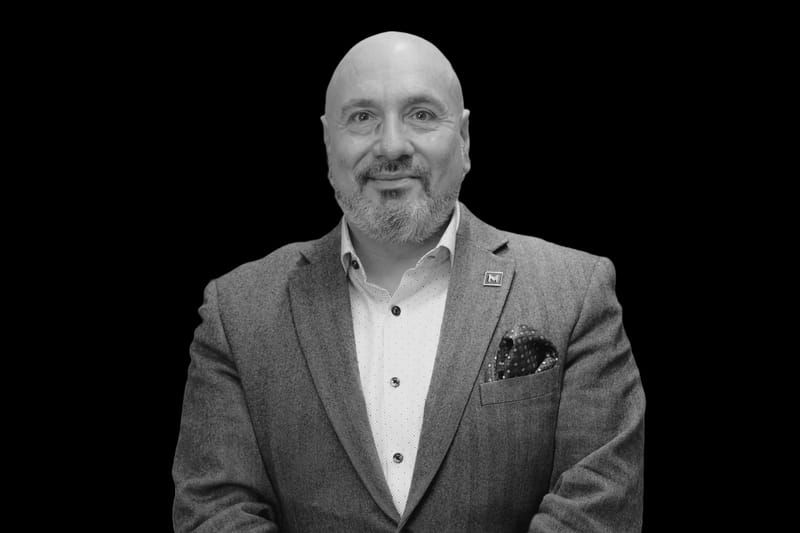
Vince Di Domenico
COO, Groupe MACH · 40 million square feet across more than 240 properties · Concordia building engineering master's
He worries about summer cooling in the middle of winter and is one of the few, he says, who flips to the last page of the CV, the one about yoga and music. A former band musician, he says managing is getting to know "the souls that you work with."
Watch · Episode 31
Born Leaders vs. Trained Managers
Recorded 2 times
Chapters
At a glance
Who is Vince Di Domenico?
- Runs
- Operations for Groupe MACH, with hubs in Montreal, Quebec City, Ontario and the Atlantic provinces
- Scale
- 40 million square feet, more than 240 properties, 450+ professionals
- Team
- Six or seven directors and VPs report to him; some 220 to 250 people in all
- Before this
- Joined MACH as Vice-President, Operations in 2015 with nearly 20 years in property management
- Off the clock
- Former band musician, soccer fan, mentor with IDU, taught the FMP program at Vanier College
Profile
he reprimand arrived by fax.
It came from an ex-boss, earlier in his career, and it was intercepted by his assistant. She read it before he did.
"I think your boss wants to fire you," she said.
"That was embarrassing," Vince Di Domenico says now. He left before it ever came to that, and the company, he says, then realized it did not want to lose him.
The story raises a question: how does a man once dressed down by fax come to run the buildings for a Montreal-founded owner-developer with more than 240 properties?
Today Di Domenico is Chief Operating Officer of Groupe MACH, the Montreal-founded owner-developer whose portfolio it describes as 40 million square feet across more than 240 properties, with 450+ professionals.
He joined MACH in 2015 as Vice-President, Operations, bringing nearly 20 years in property management, and was later promoted to COO.
Six or seven directors and vice-presidents report to him directly. Beneath them, he says, 220 to 250 people report into him "some way or another," from hubs in the Atlantic provinces, Ontario, Quebec City and Montreal.
Asked how long it took to get there, he says: "A lifetime."
"It took me almost 35 years just to get to VP level," he says.
He used to be a musician, playing in a band in front of big audiences. What that gave him was the ability "to not be shy and communicate."
Leadership, he insists, is not a diploma. "It's not something you learn."
An earlier employer forced every manager to take the Dale Carnegie course. He was resistant at first, until he realized the man's models still worked.
He was in his early 30s, and says he was surprised how many presidents and CEOs already in their 50s were there, because they had a tough time speaking in front of 300 or 500 people.
The hardest moments he describes are the ones where leading fails.
Later in his career, a group of staff members wanted to meet on their own to prepare how they would approach him and other directors. He was told not to micromanage, so he let them.
From what he heard the day after, it ended up being a night of complaints and revolution. He realized quickly that one or two individuals were orchestrating it. Once those two were dealt with, things got better.
"You don't know someone, you need time," he says. The lesson he took: there is no shame in extending a three-month probation by three more.
He has also had to part ways with staff, which he calls "always hard to do." His rule is not to break the person on the way out. "That's not what firing is."
His method starts with the calendar.
"There's 12 months in a year," he tells his hubs, "so you can't get to have a tough conversation with someone in the month of November or December."
He sits down in June instead, so that by December "we're going to be really spot on."
It extends to the weeds. In the middle of winter, with an operations manager, building technicians, directors and a VP already on it, he still asks.
"Guys, are we thinking about the cooling and our units?"
"So is that micromanagement? Maybe. Will I continue doing it? A little bit."
It also means listening. When the company was much smaller, a colleague suggested bringing in a professional who turns real estate subjects, health and safety among them, into a comedy show. Di Domenico resisted, then thought it through.
"He might have a point," he told himself. The event drew participation, and the two of them looked at each other and knew they had done it right.
What has changed is what comes back to him.
Employees have told him, "If one day you ever leave, I'm out of here." Hear it three, four, five or six times, he says, and "it's confirmed."
When he turned 60, the entire company knew. There were balloons everywhere, his office was decorated, and there was a cake bearing the emblem of the soccer team he lives by.
"I thought they were more happier than I was. And I was the one celebrating 60."
He credits his better half with keeping him grounded. She tells him when he is not humble enough, and has taught him never to forget the hard moments he came from.
He now mentors with IDU, a program where he meets 15 candidates and takes on three.
"I had no bosses that were inspiring," he says of most of his career. "It motivates me to make sure I don't let them down."
So what would he do today, angry at someone who did an awful job?
Not the fax. Not an email either. "Before getting to that point, I would have had numerous sit-downs where we can improve."
The step is his to borrow: sit down in June, not December.
You can't be a leader if it's only your way or only your method.
— Vince Di Domenico
Key Takeaways
Have the hard conversation in June, not December. He tells his teams there are 12 months in a year, and a manager who waits until the eleventh to say someone is failing has failed too.
Read the last page of the CV. He asks candidates about the yoga or the music they list, because you only get 30 minutes, maybe an hour, and the interview is not just about the degree they have.
Extend the probation if you need to. After one or two individuals stirred up a staff revolt, he learned there is no shame in asking for three more months to know someone.
Fair beats liked. He holds gatherings for birthdays and promotions, never to be popular, and says respect comes from not changing your mind from one month to the next.
Getting into the weeds is teaching. He will ask about summer cooling in mid-winter, because you cannot lead by example on something you have never done yourself.
About Vince Di Domenico
Vince Di Domenico is Chief Operating Officer of Groupe MACH, the Montreal-founded private real estate owner-developer whose portfolio it describes as 40 million square feet across more than 240 properties, with 450+ professionals. He joined MACH as Vice-President, Operations in 2015 with nearly 20 years in property management and was later promoted to COO. He holds a master's from Concordia University in building engineering and urban planning, has taught the FMP program at Vanier College and is a mentor with IDU.
Questions
On the record
Who is Vince Di Domenico?
Vince Di Domenico is Chief Operating Officer of Groupe MACH, the Montreal-founded private real estate owner-developer. He joined MACH as Vice-President, Operations in 2015, bringing nearly 20 years in property management, and was later promoted to COO. He holds a master's from Concordia University in building engineering and urban planning.
What is Groupe MACH?
Groupe MACH is a Montreal-founded private real estate owner-developer with a portfolio it describes as 40 million square feet across more than 240 properties and 450+ professionals. Founded in 2000 by Vincent Chiara, it holds 24 million square feet of land in development or for future growth, manages more than 3,000 residential units with 10,000 more planned over the next decade, and operates across Montréal, Québec, Laval, Toronto, Ottawa and Halifax. In March 2022 it closed the acquisition of 42 properties, 9 million square feet of office and retail space, from the Cominar REIT portfolio, its largest transaction to date, and in February 2026 it announced B Corp certification.
How does Vince Di Domenico run performance reviews?
Twice a year, and never as a surprise in December. He sits down with people around June to say what is working and what needs tweaking, sets objectives tied to where they want to go, and checks back six months later. "There's 12 months in a year," he says, so a manager who waits until the eleventh month to call someone awful has been a poor manager too.
What does Vince Di Domenico look for when promoting someone?
Creativity, initiative, humbleness, curiosity and the ability to articulate. MACH looks to promote internally, he says, and the people who stand out are those who take on something outside their job task because they were curious to see how it works, and who show responsibility and accountability.
Does Vince Di Domenico think micromanagement is always bad?
No. He says the only way to lead by example is to have done the work yourself, so he will ask his team in mid-winter whether the buildings' cooling is ready for summer. "So is that micromanagement? Maybe. Will I continue doing it? A little bit." He steps back once a team has shown, month after month, that the mechanism works and they take the initiative before he thinks of it.
Full Transcript
The full conversation with Vince Di Domenico, transcribed. Lightly formatted for reading.
A: How would you define a great leader? B: You can't be a leader if it's only your way or only your method. A: It's not just at the workplace, at home. We need that everywhere, right?
B: Gotta be open to numerous methods. Meet Vince DiDomenico, a leader who's redefined operational excellence as COO of GroupMak. With a decade of experience, Vince has mastered the art of inspiring teams, managing risk, and driving organizational growth. Today, he'll share the leadership insights that have shaped his remarkable career in real estate.
A: Who would benefit most from our discussion today? B: I believe that it'll touch everyone. It's not something you learn. You can't be a leader, you can't be a manager just because you went to school and, and have a certificate or diploma.
So it's either you have it in you or you don't. Really? It begins with that. You need to understand that, you need to feel that, and you need to say, you know what, step back.
How does it really work? A: Well, Vince, it's an honor to have you back. B: Thank you. A: On the Montreal Entrepreneur Podcast (now The Vault MTL), I'm thrilled because the subject at hand today is leadership, and it's not just at the workplace, at home.
We need that everywhere, right? So welcome, and please tell the people listening why you have authority on the subject. B: Well, I mean, I manage a pretty big team at GroupMak. It's made me realize that it's not like managing just one person.
Managing 250 or 220, not directly. They all have their pecking order and they have their managers that report into them. But some way or another, they're reporting into me. And so it makes me think of how to reach and approach each character because they're all different.
A: Yeah. B: I mean, everyone is unique in their own way. They're either shy, they're either good, bitter, positive, negative. So you gotta adapt to those different characters and be able to, if you can, always if you can, because, you know, you gotta want it too.
It's a, it's a two-way street. If the individual does not want, then you won't get far. But if the individual's got, has got the willingness to make an impact or to change or to at least take your criticism as being constructive, then I think as a, in leadership or in that role, Managing is getting to know also the souls that you work with, the different breed of people. A: It seems like a lot of work.
It is. B: I would imagine that if I feel it, I could just imagine an HR department having to deal with it. I look at us when we were a smaller group, it was such an easy thing. I don't think we even needed HR.
But, you know, 500 people later and so many other different backgrounds and, you know, I think we represent 37 or 38 nationalities where we work. And so everybody brings a piece of everything. And the way it's done in their country and the way it's done here and the way the laws are practiced. And so all of these things change the environment, change that landscape.
And as a leader, you need to understand that, you need to feel that, and you need to say, you know what, step back. How does it really work? You know, how does it work elsewhere outside of the province of Quebec or outside Canada? Because that too plays a role in how you effectively manage or spill that.
A: And how would you define a great leader? B: And I'm not sure that I have that guy, but I would say a great leader is someone who is able to give constructive advice, someone that should listen a lot more than I do. At times I do that wrong. Someone who's humble, for sure.
And I think someone that's ready for change. You can't be a leader if it's only your way or only your method. You've got to be open to numerous methods, or as I call them, the new ways of working. And that could be also an important ingredient to make things work a lot easier, a lot smoother, a lot better.
But I think those would be some of the qualities that that leader should have. A: And as the COO of GroupMak, how long did it take you to get to that position? B: A lifetime. You know, I said to someone a couple of days ago, it took me almost 35 years just to get to VP level.
And today, you know, I mean, you can become a VP quite, quite quickly. And then, you know, in the last probably 3, 4 years that I've been playing in this role as Chief Operating Officer, I've taken it really seriously. You know, I consider that, that role to be very close to the president of an organization, you know, and to make sure that You're there to minimize risk and to ensure that, especially for my department, which is a huge one, to make sure that we're all steering the boat in one direction, that direction that comes from a standard, a protocol that the MACC has had for a lifetime. I mean, we're going to celebrate 25 years.
So, you know, there's been a thinking, an evolution, and you want to continue that. I've been fortunate in the, you know, it's going to be 10 years this year. I've seen 10 years of that evolution or that culture. And so it's, I think, my role to also bring that forward with the team as the newcomers come on board.
A: And who would benefit the most from our discussion today? Is it other people that aspire to become COOs? Is it company presidents or those that any management positions? B: I think if you were to ask me that question yesterday, I might have had a different answer.
A: Today, today it already changed. B: Funny enough, because we had a discussion openly with your colleague before we set up for this podcast. And, you know, I believe that it'll touch everyone. It's not something you learn.
You can't be a leader, you can't be a manager just because you went to school and have a certificate or diploma. So it's either you have it in you or you don't. A: Really? B: It begins with that.
I think from a young age you get to know if you can effectively communicate, if you're a person that's outspoken, if you're a person that is not shy to speak in public. Public speaking is a big thing. I remember taking the Dale Carnegie course, an ex-employer that forced every manager to do it, and at first I was resistant until I realized Oh my God, yeah, this guy of the 1930s, but he's still effective today. And some of his delivery, some of his models work.
And so I think that you're not born with it, you have it in you, and you slowly bring out the best of what you have in you. And as a manager, you need to be open to managing fairly. You got to be fair, and you got to know what you like, what you don't like, which I mentioned earlier. That's important because whatever you don't like For sure, you don't want to spill it onto someone else and you want to help them never to get to being in that position.
A: Give me an example. Give me an example of something you didn't like your boss did, like, you know, 20 years ago, for example. B: Yeah, I mean, it's like simple things, getting reprimanded, but getting reprimanded in front of others. A: Okay.
B: Making it really public, that reprimand. A: It's like humiliation. B: And to tell you the truth, I can share the story nowadays because it's a real funny one and I'll do very quickly. I mean, I got reprimanded by an ex-boss and he did it back then.
I know this is going to sound funny to most young, the young crowd, but, you know, through a fax, right? And little did he know that when that fax came in, it got intercepted by my secretary back then. She was my assistant. And so she read it and she goes, oh my God, you're— I think your boss wants to fire you.
That was embarrassing. So, you know, I learned from that experience. It never happened because I left before I even got to that point in my career. And then they realized they didn't want to lose me.
So it's a good story, made me feel good that they didn't want to let me go. But the way the fax came in, it was a guy again with no management skills and a style that just wouldn't work today. And so I remembered that story and I said, you know what, one day, even if I'm angry at someone or I think they did an awful job on an assignment, I won't want to do that. A: Well, we don't have— B: we won't have faxes.
Yeah, I had a feeling you'd say faxes. No, we wouldn't use a fax, but I wouldn't send them an email or he or she, and I wouldn't do it in that way. It'd be something constructive. Before getting to that point, I would have had numerous sit-downs where we can improve.
I believe you can improve if you— if there's a will, you can improve. A: So basically what you're saying is that before you get to the point of firing somebody— B: Absolutely. A: Letting them go, there has to be many steps in between to see how can you reengage that person, or how can you make them change their behaviors, or whatever the reason is. B: I, I think so.
It makes a lot of sense to do that. This is like, you know, I know it's going to sound a little corny, but it's like a marriage. I mean, it's so easy to say it's not working and I really hate this and I really hate that, and you know what, we're calling it quits. quits and I'm going home back to my mom and my dad, and you do the same.
I think there's an adjustment period. You've got to be able to see the good, the bad. And how do you sit with the person and say, you know what, I really don't like this? And the other person replies, well, I really don't like that.
And how do you get to a midpoint where we're both happy? It's a win-win. A: Yeah. B: You avoid conflict.
Even in business, a real leader will avoid conflict. It's not about, you know, going legal. It's not about battling everyone. I think there's ways to still communicate speak the, you know, the right words and try to come to an understanding.
It helps avoid so much, so much frustration, so much unwanted energy. A: Yeah, definitely. And when you have to make those tough decisions, let's say it gets to that point, how do you— what's— do you have any system or how do you go about doing that? B: Well, I mean, tough decisions, if it's from an employee perspective, staff.
A: Yeah. B: Then for me, it's like I said earlier, it's being able to say, you know, did I twice a year get a chance to sit with that individual to tell them what I thought, what I thought was wrong? Maybe I'm seeing, I'm seeing it, I'm seeing it a totally different optic, but to see what's wrong and to see how we adjust, and also to hear back. If the person tells me, you know what, it's been a tough 6 months, here's how I see the, the, you know, the beginning of the year, and you adjust and you put in new objectives, you put in new priorities in place, or you just can, you know, try to give yourself some time to— for the individual just to kind of get it.
You know, everyone has the right to give it a shot and to learn it and to be confident of what they're doing. It's not— as much experience you might have, it doesn't necessarily mean that your delivery will always be picture perfect, right? Every company has their own culture, their own way of doing it. So you might have a great idea, but just with our organization, it might not work.
And it doesn't necessarily mean it's wrong. So how do you adjust? So to me, those are some of the tough moments where you've got to sit down and listen to someone else say something that maybe you deep, deep, deep inside, you probably think they're right, but you don't want them to be right just yet because you had a way of thinking that was— A: But as a leader, there is no way of avoiding those tough conversations because some people are afraid of you know, confronting as a leader or somebody who wants to be in a position of leading? B: Well, I mean, to me, there's, uh, I say this and I use it a lot with all of my hubs because we have, you know, an office in, in, in the Atlantic provinces.
We have an office in Ontario, 2 offices in Ontario, Quebec City, Montreal. I mean, I always say there's 12 months in a year, so you can't get to have a tough conversation with someone in the month of November or December and tell them how awful they were because there's 2 things there. If you say how awful you are, then that means you're saying I've been a poor manager because all I'm good for is to tell you how awful you are on the 11th month out of the 12. So to me, it's, it's, it's somewhere at midpoint in the year, let's say June, you're sitting down and you're saying you're doing well, continue on that road, and come December we're going to be really spot on.
Or you know what, we need some, some tweaking in order to get you there. Because a real manager, a real leader, is not about telling you you're fired or you're failing. It's about we got there. At the end of the year, you got to go back home with a smile on your face, right?
Everybody likes to go home with a— let's call it a spade a spade— a salary increase or, or a bonus. And it wouldn't be the right time to tell someone you're getting nothing because you're awful. That, that's shameful. And, and you're not a real manager.
A: Because I'm— as a manager, your— the end goal is to develop the person, making them better. B: Always. Yeah, always. Because you want an effective team.
You want a strong team. You want people to come to work with a smile on their face. You want them to look in the mirror and to say, I'm glad I'm going to work for, in this case, Mac. Yes, that, that is important.
That says a lot about, you know, the individual that you are, the people under you— beneath you, sorry. A: How many people do you have reporting to you? B: I would say about 6 or 7 immediate reports in terms of directors and VPs. then they have their people reporting into them.
That's the structure. So all the VPs are reporting into me for the operation department, and then obviously the directors to the VPs and the other managers to the directors, and the chain goes on. A: And when they're looking to, for example, promote somebody, can you identify some characteristics on this person? I like the way— what makes you think of this person has it?
B: Yeah, no, that's, that's a great question. I mean, we always look to promote. The idea is always to do it internally. Makes sense because they learn the business and there always has to be room for growth.
But to stand out, what I look for, at least myself, what I look for is creativity initiatives that the individual brings, the willingness, the humbleness of the individual. being able to articulate and curious. You know, you want to move up the ladder, so you're probably curious. You want to do something that normally is not in your job task, but you did it anyways because you're just curious to see how it works.
So responsibility, accountability, being able to do all of those things stands out. When you, when you see an employee doing all those things right or close to right, because there's no such thing as doing it perfect to perfection, then you say that's someone that, you know, we want to help grow and possibly you know, do 10 years with the company. So yeah, I would say those are the kind of things that— A: So during the meetings you have internally, do you speak with them, say, okay, these are the characteristics, this is what we would love you to do for you to move up? Do they know?
B: Exactly. At those moments that I stated earlier, these performance reviews, call them that. Yeah. Sometime in June, sometime in November, you're having this dialogue and you know exactly where you're going with the individual.
You know that aspiring to this new position and, and so you gear to that, you create their objectives. For that reason, you make sure that in the next months to come, they're actually practicing some of the stuff that they've been telling you they would love to do. And you put it in their objectives to make sure that you challenge them, you monitor them. And in 6 months from now, you have something to talk about and say, you know what, you're doing that right.
You're getting it. So preparing them for the new challenges. A: Why is humility important? B: So these are probably the things that I've learned the hard way, but humility is possibly in every situation that you're in, it's probably the number one thing that always comes out.
Humbleness, humility is important because if it's always about you and it's always about I've been there and that attitude that you know it all and that no one can teach you differently, doesn't get you anywhere. Whereas if you just take a step back and you say, you know what, just being humble, just listening, just appreciating someone else, whether they're right and wrong, you don't need to necessarily tell them that they're right or wrong in an open discussion. It could be something that you back and you say, wow, I've learned a lot today. That person is truly doing it wrong.
And it's still humility because you take it back with you and you say, okay. So to me, humility is, is everything. It makes the person in leadership, in, in personal. A: Yeah.
B: In your marriage, friendships. Sometimes I'm told, uh, you know, and, uh, wow, this is on podcast, but you know, sometimes I'm told you're not humble enough. And this is from, you know, my better half. And, you know, she's taught me a lot to just make sure that never forget that there are— there've been hard moments where you come from, to stay humble about it.
Everything else should follow. And if it doesn't exactly in the steps that you thought it should, as long as you kept your humility going. A: I'm thinking that this is part of the culture of GroupMak as well. So humility, somehow like the people that you want to join the company, they have to have a sense of humility.
They have to have that. Yeah. But how do you maybe during the interview, I don't know, maybe it's the HR that does that. How do you pass that on to say, oh, when you interview these people, make sure, find a way to see if they have some sort of humility?
B: You know, it's hard in an interview to ask the questions you would love to ask. You just can't do it anymore. Like, again, maybe 30, 40 years ago. A: Oh, you're humble.
B: I think you look at their CV, you look at their track record, you look at where they've been. Sometimes you also know where they've been, possibly because you know of that organization and you know what their culture is, what to expect from the person. If it's a hard company, you know, somewhere where you know for a fact that they have a proven track record for being the opposite of what humble is, then you know that that individual will probably come in mindset. A: Yeah, but it's interesting.
B: Yeah, yeah. And it helps. And so you have a good idea of what to expect from them. But I guess in an interview, interview or in a discussion, I always try to see what their past was about.
For me, past is not just about the CV and the companies they worked with. It's also that personal side. You know, some, some people write it. They say, you know, on their last page, I, I play sports, I do yoga, I do this and I do that.
But you could elaborate on those things. How many people get the chance to say, oh, you do yoga, and then you get into a discussion? So why do you do yoga? Or how's yoga like?
And what exactly do you do with this yoga? A: Right? B: And, and you should how certain individuals open up and some of the things that they probably didn't expect to be asked. Uh, you know, I know some individuals that have spoken to me about their religious beliefs, and I didn't even have to ask them.
And so you get to see that side of them and you say, oh my God, yeah, this is, uh, this is a good person. Forget the, you know, forget the work ethics or forget what the CV says, but I think at home they're— they look like they're good people. They're, they're down-to-earth people. And, and And you want those people, you want those type of people to join you.
You know, that calmness that they bring, that zen, that, um, that purity. Here, here's the word. A: So that section is very important. B: It is, it is.
But how many? I mean, you know, totally honest, and whoever, you know, gets to listen to this podcast, how many really flip to that page? I know I do. And, and you read, and there's been people that are musicians, and there's people that speak about a certain, you know, thing that they did in their past that, uh, and, and you'd be surprised what you get into the discussion deep into without having to have truly poked at it.
You just let them talk about it and it brings another, another person. A: It's true. Yeah. B: And that encourages me to see, because you only have 30 minutes, maybe an hour depending on the position, to get to know the person.
You really don't know them. Maybe even after 5, 6 months of probation, you don't know them. You can't really get to know the person that quickly. All you can do is learn and get to see how they blend in.
So that interview, sometimes it's not just about, you know, the, the degree they have. It's It's more. A: Somebody told me once that it is better to be respected as a leader than to be liked. I want to get your opinion on that.
B: That's a really, really good question. I'll tell you this, as a leader, there's this black and white zone for me. Gray is, let's say for the moment, it's not definable because I, I try not to have this gray area. And what I do believe is fairness.
So to have someone do something with you, it's with you and not for you. To be fair, to, to know that today you said it's going to be done this way, and in a month from now it's the same approach, that you haven't changed, you haven't buckled, says a lot. You can't lead effectively if you're changing your mind constantly, if, if you're trying to be liked by having events, you know, these social gatherings. I mean, we do them too as well, but I don't do social gatherings because I want to be liked and what a great boss and he's a lot of fun.
I do them because there's a merit. Sometimes it's a new employee, a new hire. Sometimes it could be a birthday. We do a lot of that.
We celebrate their birthdays. It can be a new position, a new promotion. But they know, I know that my staff knows that when we do it, there's a, there's a real reason behind it. And everything else, the business part, is just fair.
It's always fair. Like I said before, Yeah. 12 months into the year, they know that if we're going to have a discussion, it's not going to be only one way or a negative way. So how do you gain the respect?
To remain fair and credible in what you're doing. Those are important things. A: So credible, trust. B: Trust.
A: Yes. B: Yeah. I had, I had an employee tell me once, and not to get into, um, I don't want to mention the, the employee or the companies or whatever, they said, you know what, you're— I, I've had a great experience working with And if one day you ever leave, I'm out of here. And, and, and funny enough, I've heard this a few times in my career.
So I imagine— now everyone says sometimes things just because they want, they want to befriend you, or— but you know, when you hear it 3 or 4 or 5 or 6 times, it's confirmed. It's confirmed that maybe you have a positive effect on them. So as much as it makes you feel great, you say, wow. A: Do you ask them why?
B: I've earned that because they say that that I am fair, that I, that I'm credible, that they, they trust me, that they can ask me and talk to me about anything. And, and when someone is ready to commit and to say, I would leave where I am if you're no longer there, says a lot. A: Yeah. B: It says that, oh my God, there's a certain admiration for me.
Look, I mean, I celebrated, uh, so everyone's gonna know now my age, but last year I celebrated 60 years old and I didn't expect half of what was done for my birthday. I mean, all the employees knew about it, the entire company, other departments. There was balloons everywhere. A: Wow.
B: My office was decorated a certain way, and there was this happiness. They even, you know, I'm a big soccer fan, and, uh, so they even had this special cake from a team that I, uh, obviously stand by and live by. It's like my way of living. And, and so they had this cake with that emblem, and there was this joy.
I thought they were more happier than I was. And I was the one celebrating 60. And so that, so that says something. It must say something.
It must say that you must be going or trending towards a good leader when the people are as happy as you and want to celebrate with you. And I mean, we all celebrate our birthdays, but that, that marked me last year. Last year really marked me a lot, showed me a lot about how people really feel about me, the individual. A: Yeah.
B: And, um, so I would take that as positive. A: For sure. But did you always know that you wanted to be in a leadership position, like a manager, in your 20s? Did you always have that?
B: So, so yeah, in my 20s I was growing and learning the business, the career. I knew I always wanted to be somewhere in the real estate industry, but I'm not sure if I was an effective leader. What I did have is the ability to not be shy and communicate, because I also used to be a musician and, you know, be in a band and be in front of audiences and big audiences. So I always I always wanted to be with people.
I enjoy being around people. I enjoy giving them that show or that entertainment. And so knowing that I had that ability, it was easier for me to do speeches, presentationals, or being able to be out and speak out. So I knew that that part was important if you want to follow a managerial position and eventually be that effective leader, because it requires for you to speak.
A: Yes. B: It requires you not to be shy. It requires for you to do what we're doing now. No, just being honest and being truthful and just looking at the person and saying, here's who I am, and, and not to change who you are.
A: But what are you saying though? Like, what if a shy person become a leader eventually? B: I think that that's possible. Uh, I, I was surprised when I took the Dale Carnegie course how many CEOs of organizations that were there of a certain age— they weren't all in their 20s.
I was in my early 30s, and there was individuals there that were already in their 50s. I had never spoken. They were presidents of companies or CEOs organizations, but they were at that course because they had a tough time being in front of 500 people or 300 people and speaking and articulating, uh, possibly because they lacked confidence. So you were a smart person, you were able to make decisions for the company and lead it to a profitable environment and, and bring them forward, but you weren't able to do it and you had in front of people, you let someone else do it.
A: Yeah. B: So you might have been the brains behind it. Sorry, but you couldn't communicate effectively to the audience. A: So then in a case like that, it's better to partner up with somebody that can communicate?
B: Absolutely. A: Yeah. B: Today it's great. There's so many programs, these mentors and mentorees that— and I'm involved this year again for IDU where I'm a mentor.
And it's so great to see the people that actually want to partner up with you. Right. There's a selective program and then you get to choose the, the 3 individuals that you met of the 15 individuals. And it's funny enough, when they partner you up, the people write back, they say, wow, I'm so glad I, you know, chose you.
And that makes me feel good because it's inspiring. It motivates me to make sure I don't let them down. So whatever I know, good or bad, and whatever I didn't like or liked, how can I share it with you so that you can take it with you and, and do something with it, probably possibly better than I did? But I believe that it is possible.
And today a lot more because you can actually partner up. A: Definitely. Now we'll check. So you are a mentor at IDU?
B: Yeah. A: That's nice. I'll take a look at that now. B: It's a cool thing.
It's a cool thing. And you talk about everything in a business environment or context, but also on a personal level and just how to achieve. You know, some of the questions are very similar to what we're doing today. You'd be surprised how many people want to know certain things or they weren't sure of, not because they don't know how to do it.
They're very intelligent. Most of them are all educated. A: And what are some of the common questions you get? B: Well, how did you tackle this particular assignment or this, this conflict?
How did you resolve it? Or do you think I should go about it this way or that way? It's, it's, um, it's inspiring. You get to see a side of you and, and, you know, they're asking for advice.
The one thing you don't want to do is give them wrong advice or tell them this is the only way to do it, and then they go out there and say, but you know, this guy that I met told me this is the way to do it. So you have to be careful. But yeah, there's, there's, there's this possibility nowadays to learn from others, which we did not have. I know that in my career it was very hard.
I had no bosses that were inspiring. Maybe in the last, I would say, 10 years that's happened to me. I've had those kind of individuals surround me and you learn from them. A: them.
B: But previous to that, we— the mindset was there, the culture wasn't there. A: So you had to make all the mistakes and you make the mistakes, you learn the way you had to learn. B: And sometimes it wasn't always right. But today we're fortunate that you have those mentors.
Yeah, evolution has done a great thing. A: Can you think of a particular conflict since you just mentioned that people were asking you, you know, how to resolve certain conflicts, but personally, a conflict that you had to resolve resolved, and maybe at work, and how did you go about resolving it with tact or techniques? B: Yeah, sure. I mean, if I keep it work-related, you know, there are— there have been in the last 10 years, and even earlier on, but if I speak the last 10 years, there have been moments where I've had to part ways with certain staff members.
They're always hard to do, to sit in a room to say to someone it hasn't worked out after everything that I've preached in the last half hour about, you know, performance reviews. There comes a where you have no choice and, and you have to face that moment where it just— everything has failed, it hasn't worked. And so you've got to do it in a way where you don't break the person. Because just saying someone, we're letting you go, for instance, sounds simple enough, but you're not sure how you're going to leave that individual.
One, are they expecting it? A: Yeah. B: Two, if they're not expecting it, even worse, their mindset leaving the office You know, there was a time where we would leave the office if we were fired and the security guard would escort you to the front door immediately the same day. I think nowadays it's— we've evolved to being better people.
We allow people to do their 2 or 3 weeks in the organization without having to leave on that same day and to give us the 2 weeks notice and to actually work for them. A: Mm-hmm. B: So being in a situation where it turns to be negative, it turns to be something that you weren't expecting, like sour or bitter, you've got to be able to understand what and how you leave the individual. It's important.
You know, how do they return back home? Do you break them so that they're not confident anymore for a future job? Doesn't mean because they weren't good in performing the task that you gave them in your organization that it means they can't do it elsewhere. So that is possibly a hard thing to do because you've got to make it happen.
A: You know, it has to get done. Somebody has to do it. B: Yeah, 10, 15-minute thing has got to happen and you're not dialoguing for hours. hours.
But you got to be cognizant that you're not here to break the individual and break their confidence or destroy them. That's not what firing is. Not only about, you know, destruction of a person. It's possibly because it just didn't work out for many other reasons, right?
And it could be personal, like it could be they just didn't have the bandwidth or capacity or ability to get that particular function to the threshold. A: Is that something you do with HR in your particular case? So you have to make those decisions. B: We always have HR next to us.
Actually, that individual accompanies us to ensure that they're also there to observe and be a witness to a situation, because there's some that take it to the next extreme, right? It could be a violent dismissal. It could be words that were not said. So you've got to make sure that you always have someone there recording or writing or observing what went down and what was said, just to protect yourself as well.
Because there are good people, but in the same breath, there are bad people as well. A: Can you identify them? B: The good and bad? A: Yeah.
B: Well, if I take the easy one, the bad is— it probably starts and it begins in your own home, right? I mean, you can't be bad, you can't be a thief or someone that beats on someone if that's not how you were raised or what you saw in your own home. A: Yeah. B: So when you see someone, for example, beating on a, on an animal, a dog or a cat, right?
Well, then you can expect how they're going to be when they're in a relationship in the future, right? That for me is bad. And therefore, in a workforce, in a work environment, that same individual is probably going to be that individual that's going to stir up a situation, whether it's with a colleague colleague or colleagues, whether it's going to be in twisting certain words. A: But can you see it coming?
Can you see it coming from far? Like, oh, that person. B: Sometimes. Sometimes the demeanor of the individual kind of gives it away just in the way they talk.
If it's all about them and if they're spoken with a certain profanity, believe it or not, people do come to interviews and it escapes them and they do sound a little rough and you can tell that's not going to work. And then the good, I mean, I mean, the good, you see it right away in the individual. I think if you're good, you're good. Just in the way the person confronts you or, or smiles at you or shakes your hand, you can tell a lot about the individual.
You could be wrong, but I would say out of 10, it's worked 8 out of 10 times. It's worked for me. A: Yeah. B: You can almost sense that individual.
Today you can't really call anyone for references, right? Because no, everyone is afraid. They're not going to really give you a good reference or a bad reference. But, uh, so they stay away.
So you try, if you do call, hopefully the call will be something like, well, I have no comment, or well, I couldn't tell you more than, you know, that kind of gives it away a bit. But so you're really forced to get to know it, uh, on your own, probably the hard way. A: Seems like being a leader is a lot. B: It is if you want the organization to prosper.
And if you don't do it well enough, then you've got a lot of of bad people around you in an organization of everything that we just said that we don't want. And then that's not good. A: And that creates chaos. B: It creates chaos.
That's a good word, chaos. You know, you got this revolution on your hand. It's not good. You got to be careful.
What you don't want to build is that type of environment. And I've been through an environment like that, even where I work now. There was once upon a time a bunch of staff members that kind of had their, you know, mini revolution going on and they wanted to revolt and had their way of thinking. And it surprised me because I was being told not to micromanage, to let it be, let the people get together.
They want to discuss certain things so that they can approach a certain situation with you and with other directors in a certain way. And I allowed it, you know. I said, yeah, yeah, for sure, I don't need to be everywhere, and let them be. A: Yeah.
B: And it turned out to be— it turned out to be a night of, um, from what I hear, because I heard the aftermath the day after, it ended up being a night of of complaints and revolution and everything is wrong and how they were gonna come back with this attack approach. And I realized quickly that everything that was being said and done was being orchestrated by one or two individuals that were bad, that were exactly what we just discussed, that had in them this way of wanting to create chaos or fueling the fire. You know, the minute we kind of approached those two individuals or dealt with those two individuals, things got better and we learned. That was a perfect lessons learned.
A: What did you learn? B: I learned that we need more time. We need to evaluate when you're in interviews. We need to ask sometimes the right questions.
We need to give ourselves time. Sometimes there's no shame to say to someone, here's your 3-month probation, and after your 3 months, I'm not 100% sure. It doesn't mean you're a bad individual. I want to extend the probation period for 3 months longer.
I want the ability to get to know you. You don't know someone, you need time. And I think if we as leaders give ourselves and admit that time is important, it does so, so much good. So those were type of events that taught me a lot too, even, you know, later on in the career.
And you say, wow, this was a big one. And again, you know, it wasn't about micromanagement, it was just about individuals wanting to create something that wasn't there. A: Because micromanagement, yes, it's a, it's a buzzword. People don't like that.
How you effectively hold somebody accountable with what they have to do without it being perceived as you being micromanaging them? B: Yeah, I've been told that sometimes I micromanage, but then I've also been told that micromanagement— or I've learned this from others— that is not a bad thing. The only way you can effectively manage and lead by example— that's the one thing I was looking for earlier, lead by example— is to have been able to have done it yourself. And sometimes micromanaging is not necessarily a bad thing.
Micromanaging might mean that, hey, I've got to get myself into the weeds of things just to ensure that what I think you should learn or get out of this, you will. And if you don't do that, and if you're always thinking high level and that you're too high level to get into the weeds, you'll never be able to teach it. And to me, it's teaching it. You know, I used to teach at Vanier College the FMP program.
I think I said that in my last podcast. But so I had students from, you know, different disciplines and different experiences of life. They're already working in property or facility management. And some of the things that I would do is, is actually go into those details, going— although they might know.
I mean, someone that's been in the career for 20 years doesn't need for me teach them their business, but sometimes to go into a deeper discussion of what to expect, what not to do, and how to do it. And some— so sometimes people think that that's micromanaging. And I do that sometimes at work for that reason, to ensure that, hey, did you think of this? For example, you say, you know, you're, you're a chief operating officer.
Do you really need to worry that summer is coming And in our business, the tenants have to make sure you have cooling. We're in the middle of winter, you're worried about your cooling, air conditioning. And, and so you have people that know to do that. You have your operation manager, you have your building technicians that should be geared to that, you have your directors, you have your VP.
But sometimes it's stronger than me, and I actually, you know, throw myself into that pool and I say, guys, are we thinking about the cooling and our units? Are we ready for them? Because you want to make sure that when trouble does hit, it doesn't all come tumbling down on you. So is that micromanagement?
Maybe. Will I continue doing it? A little bit, to make sure that, uh, we don't get the, the poor result that no one wants. A: It does have a bad connotation, but if it's making sure, ensuring that things will get done or that they're being done properly, I mean, this is the— B: There's nothing wrong with it.
Yeah, if it's done constructively, I don't think it should be perceived as micromanagement. But being involved means, again, you said a good word earlier, you're passionate about it and you want it to work. You're not going to always be everywhere at the same time, but if you can, uh, if you understand it, if you want to visit that property, for instance, if you want to do it more than one time, often enough, or do it with individuals because you want to teach what you see through your lenses, that's great too. Yeah, that's great.
There's no shame in that. A: No. And when do you know that— now there's a balance. Yes, stepping in.
When do you know when to step back? B: The stepping back is a little more scientific, right? Um, but I would say that when your team is following a certain standard, a certain protocol, and they've shown time after time, month after month, or year after year that the mechanism is working, uh, that they're taking the initiative even before you thought about it, and they have it programmed for you, and they're showing the results, then I think you can step back a lot more freely. Uh, so, so, uh, this equates to time.
You know, with time you get to see the progress, you get to see the confidence that people build up. Once they have confidence, once they're assured of themselves, you should be able to step back easily without having to worry. A: Yeah, so then you have to play it by ear, like, are they ready, are they not ready? So, so, because if you let go, if you step back too soon, then we're asking for trouble, basically.
B: Yeah, something like that. And I think you get to see if we're able to step back just during evaluations, just to sit down with the individual to see where they are in their, in their journey, in their journey to success. How, how are they evolving? And that should be— it should be confident enough to know if they're achieving their results.
If they are, then you don't need to micromanage them, and you don't— and you can actually Let them, you know, let out the rope a little at a time and say, I'm good. There's a trust building, that confidence, that trust. A: And when there's conflict that you have to manage between the team, do you believe that there is something that we need more on emotional intelligence to see how can you bring the team, the harmony back in the office? Because you said you have different type of, like you said, 38 nationalities, right?
Like you had to learn how do they do things maybe in their country. the culture, to make sure that when you sit in front of those individuals, maybe that 2 of them have a different conflict so that you understand each perspective. Does that need something else more like your intuition? Does it get involved so that you create that harmony between them?
B: A couple of things would happen if this was me, and I'm speaking out of my experience. The way I do it is you got to listen to both sides. sides. A: Yeah.
B: You've got to be able to listen. I've been told that that's a real important one— listening. Listening is key to a lot of things. So listening, making sure that you truly understood it, because there could be things that are being said, and if you're not familiar, if you're not educated enough on that subject or whatever the context might be, it could lead you to making the wrong decision or possibly favoring one alternative over another.
So listening and the ability Coaching. A: Coaching. B: Coaching. This is, this, this is, this is also maybe a key factor for me.
Coaching in the right way. Coaching to me is also meaning being able to recognize that if you can't do it, that you can actually go out there and get the help that you need to do it. So training is, is, is a big one. Uh, training could be simple things.
For example, you want to get a message across and you feel you don't know how to do it well enough. I've had in the past invited guests that were, um, comical in their approach. They're, they're, they're actually, uh, they're actually real professionals. They come in and, uh, and they're particularly, uh, focusing on real estate, and but they'll turn it into a comedy show Interesting.
And so the people that are in the audience from all these different disciplines or cultures that might have a hard time approaching their boss in a certain way or the boss approaching them in a certain way to deliver a message, they do it. They do it in a more comical approach and they're touching on all the subjects. Example, health and safety. We speak about health and safety and it's like a taboo or for some it's not really priority, but yet it's one of the most important things.
In our company, it's tolerance is zero. And especially now that you're 500, there's a lot more instances. There's a lot more situations that happen, whether they're personal situations because someone had a respiratory issue to someone that fell off a roof. A: Yeah.
B: But we've had in the past professionals come in, comedians, let's call them that. And they delivered part of their program program, this health and safety thing, and gave it a twist, more comical. But at the same time, the message was, hey, you don't— you got to think this through. Health and safety is important.
So I think the coaching and the listening are too big to making sure that you can deliver your message more effectively. A: Very interesting. I like that, that you had to bring— you bring it. So if there's a message you cannot deliver, go get help.
Wait, bring them in so that you can touch the person's heart, or in a way to communicate effectively. B: And quite honestly, we said earlier, you know, humility, humbleness. If I would say you that that's an idea that I had alone would be wrong. A: Mm-hmm.
B: I was resistful to something like that, and an individual that now is no longer with us at MACC, and this is already going back 7, 8 years, said to me, you know what, we should do what we did in the past in a previous organization we were working for. Why don't we bring this person and why don't we deliver this message? We'll talk about a lot of things, but it's going to do a lot of good to the people At the beginning, it was very resistful until I thought it through and I said, you know what, he might have a point. This individual might truly have something there.
And we did it, we pushed it. Kind of looked like you were speaking a different language when we brought it up, the event that we wanted to do, but it worked out. I saw participation and we both looked at each other, this individual and I, and we knew we had done it right. We knew that somewhere underneath it all, we were kind of the ones that created this initiative.
initiative in our favor. Obviously, it's always a little awkward, but to those that don't understand why we're even doing it, but it had an effect early on. Yeah, that if we were to repeat it today, we'd do it, you know, probably in the same way, but we know exactly what we want to deliver, exactly and specific pinpoint to, to where we want to bring the conversation. A: So it's a good thing you listen to, uh, you, you know.
B: So that's probably listening too, right? They say I don't, but that one time Because it's a big decision. It is. It is sometimes because it's hard to approach, right?
You don't know the company being a lot smaller back then, coming up with an idea like, you know, let's, let's, let's do this social gathering and we'll have this guy kind of clown around with some subjects, but then speak to this effect and that effect. It's not always easy, but it has merit. It has merit. A: So you were able to convince the team to— they don't understand why you're doing it, but to follow along.
B: And I think it worked out. It was a nice thing to see evolve and you had something to do with it. Doesn't mean that it's all yours and it's all your idea, but you had— you played a part in it and that was a lot of fun. A: The humility part.
It's not just you. Yeah, everybody. I like that word. And did we miss anything?
Is there something you find like there's a message that we, the audience, should know about the topic that we discussed today? B: No, I mean, We, we covered— for me, really meeting with you was to discuss, to make sure that out there the people don't look at themselves and say, am I a poor, bad manager? It's just recognizing that there is a way to do it. There's so many books, so many books have been written about leadership, but we read them and I'm not sure if we really read them with that um, with that, uh, result that we're looking for.
Uh, I wanted people to hear us speak about a subject that doesn't require just that expert to come in and preach how to do it. One, it's got to be within you. You've got to have it in you. You've got to want to be with people, and you got to want to see the good, be constructive.
And so to me, that's the message, that if there's someone there managing out there and have a small staff, a big staff. It's remember the people, remember who they are, remember— and remember yourself. Really remember what you don't like and, and if you— and what you do like, and use it. Use it to do something creative and effective, to, um, to be that, that the good leader.
A: Well, that summarized the whole discussion that we just had. B: Thank you very much. A: It was a pleasure to have you back on the Montreal Entrepreneur It was fun being here. B: I enjoy your, your questions, and, uh, I think you bring them out.
You know, you have a way of, uh, having your guests speak out and, uh, possibly, you know, surprising themselves as well of what they're gonna say and how they're gonna do it, because you, you give the other person the chance to, uh, think it through. Um, you know, some of the stuff I say, I retain, and I say, wow, maybe I should have done it that way after all. But I really appreciate it. A: Thank you.
B: I hope we touched the right people. A: to believe in. Yeah, for sure, for sure. B: And that's what we're here about.
A: Well, thank you so much. B: Thank you. Thank you for having me.
Sources
- Chief Operating Officer, Groupe MACH; name spelling Groupe MACH, Our Team
- MACH portfolio of 40 million square feet across more than 240 properties; 450+ professionals; 24 million square feet of land; more than 3,000 residential units plus 10,000 planned; founded in 2000; cities of operation Groupe MACH, About us
- Appointed Vice-President, Operations in August 2015; nearly 20 years' experience in property management at the time; master's at Concordia in building engineering and urban planning Groupe Mach press release, August 6, 2015
- Promoted to Chef de l'Exploitation (COO) of MACH Groupe MACH LinkedIn post
- Acquisition of 42 Cominar REIT properties, 9 million square feet, closed March 1, 2022, MACH's largest transaction to date CNW / Newswire, March 1, 2022
- MACH announced B Corp certification, February 25, 2026 Groupe MACH news
- Six or seven direct reports; 220 to 250 people reporting into him indirectly; hubs in the Atlantic provinces, two in Ontario, Quebec City and Montreal; 37 or 38 nationalities; almost 35 years to reach VP level; former band musician; soccer fan; 60th birthday celebration; mentor with IDU; taught the FMP program at Vanier College; Dale Carnegie course in his early 30s In conversation with The Vault MTL
- Fax reprimand from an ex-boss; staff revolt orchestrated by one or two individuals; colleague's idea to bring in a comedian for health and safety; employees saying they would leave if he left; his better half telling him to stay humble His account, in conversation with The Vault MTL
More from The Vault MTL
The Dispatch · The Vault MTL
A monthly record of Montreal’s most consequential founders.
Once a month. No fluff.